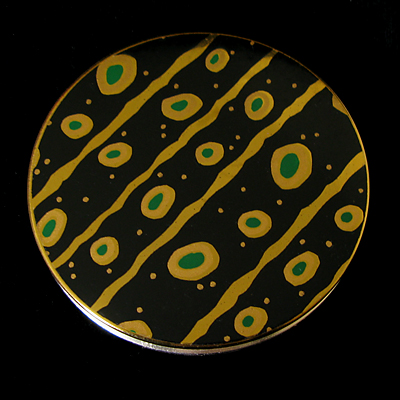
Powder compact, gilt and enamel with engine-turned pattern on the back. ‘Made in Great Britain’. 1950s/1960s. The design on the lid of the powder compact is a simple pattern of circles and squiggly lines, probably representing atoms, a lively optimistic piece from the 1950s when scientific progress was widely celebrated in everyday objects. The splitting of the atom in the 1930s and further research in the 40s and 50s lead to the science of nuclear fission and initially to a period of optimism about the potential applications of this new source of energy. The 1950s also saw huge developments in space science, medical research and computer engineering. Television developed into a mass medium. Symbols of these new discoveries found their way into the architecture, textile design and industrial design of the 1950s. In 1951 the Festival of Britain was held to showcase British achievements in architecture, science, technology, and the arts and to boost the morale of the nation after the end of the war.
However, optimism was gradually replaced by a growing fear of the destructive power unleashed by the development of nuclear weapons. This fear persisted throughout the 1960s and 70s – I remember as a 12-year old the Cuban Missile Crisis of 1962 when for 13 days the world teetered on the brink of nuclear war. The tense situation between America and the Soviet Union was eventually resolved through secret behind-the-scenes negotiations and the exchange of letters between Kennedy and Khrushchev. One outcome of the crisis was the establishment in 1963 of the ‘hotline’, a direct communications link between Moscow and Washington, which hopefully is still in use today.
 Retromode