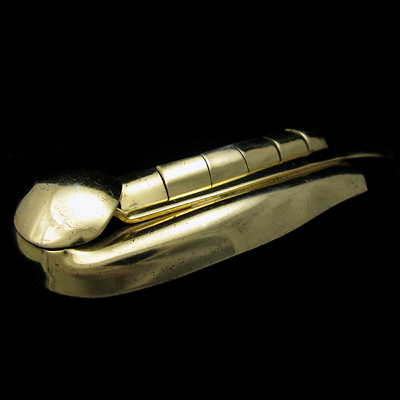
Egyptian Revival Brooch by the Napier Company
Some years ago I unearthed this gold-washed brooch in one of my favourite hunting grounds. Although this didn’t require months of hot, dusty toil in the desert, it did involve hours of concentrated effort searching the hidden corners of the online treasure chamber, which is eBay.
I remembered the brooch after watching the newly released film The Dig, and recovered it from my collection stored under the bed, where else. The movie describes how Edith Pretty, played by actress Carey Mulligan, discovered the medieval Anglo Saxon treasures at Sutton Hoo in Suffolk, England in the late 1930s. Interestingly the Sutton Hoo treasures also spent a short time safely hidden under her bed. As an adventurous young woman from a wealthy background, Pretty had travelled the world, and in Egypt with her father she had witnessed the excavations taking place in the Valley of the Kings. In later life, as the owner of the Sutton Hoo estate, her earlier interest in archaeology led her to employ local amateur archaeologist Basil Brown to undertake the excavation of the earth mounds near her home. After the initial find by Brown of a large 90 foot ship-burial, dating from 625AD a full scale excavation by a team of experts was undertaken. Like the pyramids, the mounds proved to be burial chambers, protecting kings and queens and their treasured possessions of intricately worked gold, silver and precious stones. With the richest, intact Anglo-Saxon ship-burial found in Northern Europe, Sutton Hoo might be regarded as Britain’s Valley of the Kings.
The discovery of Tutankhamen’s tomb by British archaeologist Howard Carter and Lord Carnarvon in 1922 in the Nile Valley was one of the major archaeological discoveries of the 20th Century. Following the upheaval and miseries of WW1, the finding of the incredible treasures and the story of the boy king who reigned from 1333-1323 BCE in Egypt created huge excitement. Through mass media, the news of the excavations and fabulous finds spread quickly to a worldwide audience. Americans in particular were fascinated – Tutankhamun, Howard Carter and Lord Carnarvon became as famous as today’s celebrities. President Hoover even named his dog ‘King Tut’. This obsession led to the large scale commercial production of jewellery, ceramics, games, costumes and posters, inspired by the ancient artefacts of Egypt. In the 1920s / 1930s the Napier Company, a major fashion brand in New York, produced a range of Egyptian Revival jewellery, the brooch pictured above resembles the sarcophagus or gold coffin of Tutankhamen.
Costume jewellery was normally produced using base metal with silver-tone or gold-tone finishes but owing to a shortage of metal during the war years, some was produced using gold-washed sterling silver. There was also a revival of the Egyptian style in the jewellery of the following decades, often in the form of bib necklaces, choker collars, snake chains and scarab brooches.
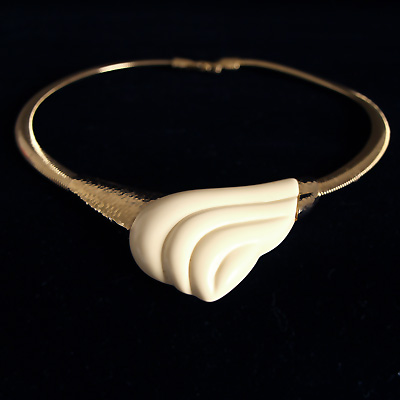
Trifari Lucite and Gold-tone Necklace
The interest in Egyptian Revival actually began in the late 18th century with Napoleon’s North African campaign, when the desire for the exotic style spread throughout Europe. The demand boomed in the 1920s / 1930s and has recurred in waves every few decades.
This Trifari necklace is a lovely example of Egyptian Revival costume jewellery from the 1970s /1980s with the bright gold-tone, flat snake chain, hammered gold-tone and carved creamy lucite shell or wave centrepiece. Founded in the USA in 1910, Trifari is one of the most respected manufacturers of high quality costume jewellery. Post WW11 they created their own metal mix, Trifanium, a base metal with rhodium finish which did not require polishing, and marketed so sucessfully it was worn by America’s First Lady, Mamie Eisenhower. More recently Madonna has worn Trifari. They have produced a huge variety of styles by many talented designers and these are still highly desirable.
So, there are still treasures to be found if you are willing to search, bearing in mind that all that glitters is not gold.
 Retromode